


40-42 Hatton
Garden London
EC1N 8EB

On the 11th of June, the world will witness the world’s greatest sporting event, ever. With 48 national teams and 104 matches spanning thousands of miles across the three North American nations, this is the 2026 FIFA World Cup. The world’s biggest sport, the most anticipated tournament in its largest ever format, set in the largest sporting market. This is the gateway through which previously novel technological sports solutions have entered the mainstream. In 2014, FIFA’s goal-line technology made its World Cup debut on Brazilian soil after its approval two years prior, while VAR having been introduced in 2017, was officially introduced to the tournament in the 2018 Russian World Cup. Most recently, the SAOT (Semi-Automated Offside Technology) appeared on the global stage in Qatar 2022. What will we see in 2026?
Since Argentina lifted the World Cup on the night of 18th December 2022, AI has taken the world by storm. The rise of agentic AI, from GPT-4 through to agents, has unveiled itself within a single World Cup cycle. It is no surprise that 2026 would be the first tournament integrated with FIFA’ and Lenovo’s Football AI Pro, a generative AI assistant, that leverages FIFA’s database of 3D visuals, graphs, text and video, to support analysts and coaches of all 48 teams. This will be built on FIFA’s novel 3D digital twin avatar of every squad member. Every player will undergo a one-second body scan. These 3D avatars will be integrated with SAOT and VAR to push the limits of accurate calls. Referees cams too will be enhanced by AI-powered stabilisation models which reduce motion blur for clearer real-time and visual perspectives for high-pressure decisions in the most crucial moments on the pitch.
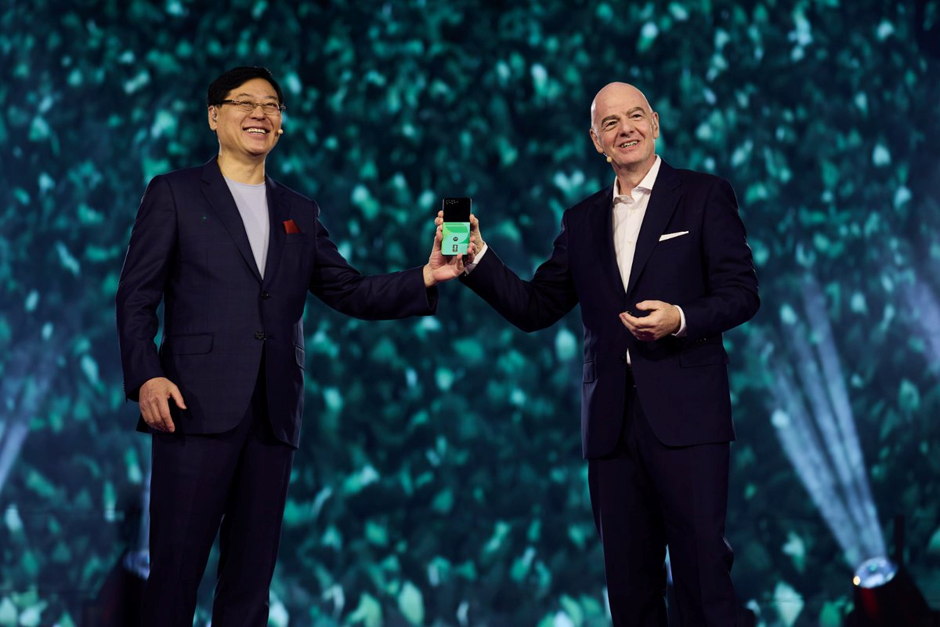
Yuanqing Yang, CEO Lenovo, and Gianni Infantino, President of FIFA, unveiling a slate of AI-driven innovations for World Cup 2026 at CES 2026 (Source: FIFA)
But it’s not only FIFA that has made strides within the 4 year wait for the next World Cup. Fox Sports has seized their homeground advantage in North America and have developed BRISK – the Broadcast Remote IP Studio Kit. This portable set of server racks set on wheels enables Fox to seamlessly switch between camera views separated by thousands of miles, via a digital connection connected via digital feed. The producer will get a uninterrupted oversight panning from the Pacific to the Atlantic as if the continent had been shrunk into a single studio. The audience in turn would witness near-zero visual latency, as Fox Sports draws upon Unreal Engine’s image rendering, as well as GhostFrame technology. This latter innovation refreshes LED images at rates faster than the human eye can perceive, pushing the frontiers of the virtual stadium experiences, bringing live atmosphere to the comforts of home, on your very own screen.
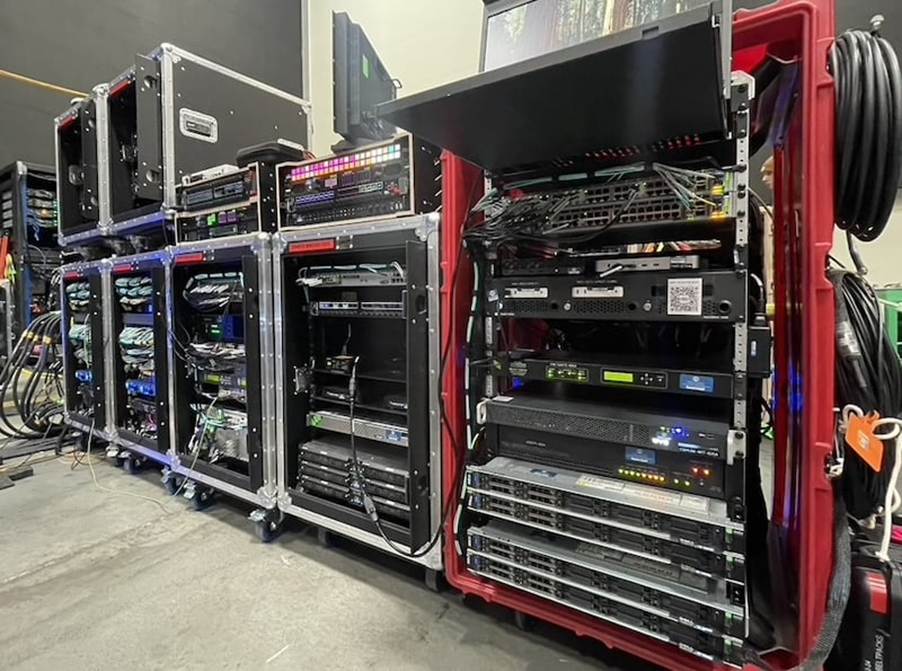
BRISK: Broadcast Remote IP Studio Kit, a portable set of server racks set on wheels enables Fox to seamlessly switch between feeds separated by a continent (Source: SBJ)
For the fans on site, FIFA has expanded its AR features on its FIFA+ app, letting fans at the stadium track real-time player stats on their phones, simply by pointing their mobile phone cameras. As a melting pot melding the Anglophone and Hispanophone realms, the 2026 World Cup will also witness Telemundo, the exclusive Spanish rightsholder, run a fully integrated second-screen layer with live social watch parties engaging influencers offering real time reports on YouTube, TikTok and X, hinting at the beginning blueprint for future multilingual platform-native sports coverage integrated with the first screen rightsholders. Telemundo’s multi-platform approach recognises the increasing importance that mobile devices play in the consumption of live sports and that this World Cup could be the springboard for major shift toward a mobile first-screen experience for the fans.
But none of these technologies were born at the World Cup. Many have humble beginnings as ideas sparked within the realm of researchers and entrepreneurs. A quarter century ago, an AI researcher at Roke Manor with a PhD in AI from Durham University conceived the idea of a ball-tracking system during an internal innovation exercise for cricket. After years of innovation and refinement, Hawk-Eye was founded, and together with GoalRef’s magnetic field-ball sensor, and the controversy of Frank Lampard’s ghost goal versus Germany in the 2010 World Cup, saw its introduction to the 2014 World Cup. What about today? What would today’s start-ups hold for the World Cups of tomorrow?
In its teething stages R-VARS (Reportable VAR) was first presented at the 2025 ACM International Conference on AI and Computational Intelligence. This research-start-up hybrid is building a system that automatically detects fouls using computer vision to provide referee recommendations while allowing referees to make the final call on the pitch. For the screen, Spiideo has introduced an AI that to fully automate live broadcast production workflows, enabling crew-less operations from camera direction and cutting to streaming. Could this be the new mainstream solution of a 100+ matchday World Cup? Elsewhere, looking to push the boundaries of immersive virtual stadium experiences, Quintar has developed a spatial AR overlay for live digital content in real-world sports events. Parallel to these software fan engagement innovations, new hardware technologies are being developed to recreate the acoustic experience of being in the stadium, at home, with breakthroughs in head-tracking spatial audio.
Every 4 years, the world summits the peak of sporting achievement and that of sports, media and cultural technology. But unbeknownst to the masses, best innovators and entrepreneurs have already begun their ascent to reach the peak. Which budding technologies today will earn their place in the World Cup tomorrow? Time will tell which start-ups will win their World Cup.
https://www.itvmedia.co.uk/catch-the-latest/fifa-world-cup-packages-2026
https://news.lenovo.com/pressroom/press-releases/football-ai-pro-powers-intelligence-across-the-game
https://inside.fifa.com/innovation/world-cup-2022/goal-line-technology
https://inside.fifa.com/innovation/world-cup-2022
https://www.knvb.com/strategy/new-laws-of-the-game/refereeing-2.0 https://www.bbc.co.uk/wales/raiseyourgame/sites/concentration/getyourkiton/pages/paul_hawkins.shtml
https://www.nbcuniversal.com/article/telemundo-redefines-multiplatform-viewing-experience-spanish-fifa-world-cup-2026tm https://thenextweb.com/news/startup-spiideo-automating-sports-broadcasting-ai
https://venturebeat.com/business/quintar-raises-3m-for-live-sports-and-entertainment-ar-platform https://smartseries.sportspromedia.com/news/ar-quintar-q-reality-funding-seventysix-capital-intel-sports-technology
https://www.mlssoccer.com/news/mls-next-pro-launches-historic-ai-driven-multi-language-broadcast https://www.broadcastnow.co.uk/production-and-post/french-football-to-get-ai-generated-multilingual-commentary/5203128.article

Ready to take your sports start-up to the next level? Let's collaborate and redefine the game together.
On the 11th of June, the world will witness the world’s greatest sporting event, ever. With 48 national teams and 104 matches spanning thousands of miles across the three North American nations, this is the 2026 FIFA World Cup. The world’s biggest sport, the most anticipated tournament in its largest ever format, set in the largest sporting market. This is the gateway through which previously novel technological sports solutions have entered the mainstream. In 2014, FIFA’s goal-line technology made its World Cup debut on Brazilian soil after its approval two years prior, while VAR having been introduced in 2017, was officially introduced to the tournament in the 2018 Russian World Cup. Most recently, the SAOT (Semi-Automated Offside Technology) appeared on the global stage in Qatar 2022. What will we see in 2026?
Since Argentina lifted the World Cup on the night of 18th December 2022, AI has taken the world by storm. The rise of agentic AI, from GPT-4 through to agents, has unveiled itself within a single World Cup cycle. It is no surprise that 2026 would be the first tournament integrated with FIFA’ and Lenovo’s Football AI Pro, a generative AI assistant, that leverages FIFA’s database of 3D visuals, graphs, text and video, to support analysts and coaches of all 48 teams. This will be built on FIFA’s novel 3D digital twin avatar of every squad member. Every player will undergo a one-second body scan. These 3D avatars will be integrated with SAOT and VAR to push the limits of accurate calls. Referees cams too will be enhanced by AI-powered stabilisation models which reduce motion blur for clearer real-time and visual perspectives for high-pressure decisions in the most crucial moments on the pitch.
Yuanqing Yang, CEO Lenovo, and Gianni Infantino, President of FIFA, unveiling a slate of AI-driven innovations for World Cup 2026 at CES 2026 (Source: FIFA)
But it’s not only FIFA that has made strides within the 4 year wait for the next World Cup. Fox Sports has seized their homeground advantage in North America and have developed BRISK – the Broadcast Remote IP Studio Kit. This portable set of server racks set on wheels enables Fox to seamlessly switch between camera views separated by thousands of miles, via a digital connection connected via digital feed. The producer will get a uninterrupted oversight panning from the Pacific to the Atlantic as if the continent had been shrunk into a single studio. The audience in turn would witness near-zero visual latency, as Fox Sports draws upon Unreal Engine’s image rendering, as well as GhostFrame technology. This latter innovation refreshes LED images at rates faster than the human eye can perceive, pushing the frontiers of the virtual stadium experiences, bringing live atmosphere to the comforts of home, on your very own screen.
BRISK: Broadcast Remote IP Studio Kit, a portable set of server racks set on wheels enables Fox to seamlessly switch between feeds separated by a continent (Source: SBJ)
For the fans on site, FIFA has expanded its AR features on its FIFA+ app, letting fans at the stadium track real-time player stats on their phones, simply by pointing their mobile phone cameras. As a melting pot melding the Anglophone and Hispanophone realms, the 2026 World Cup will also witness Telemundo, the exclusive Spanish rightsholder, run a fully integrated second-screen layer with live social watch parties engaging influencers offering real time reports on YouTube, TikTok and X, hinting at the beginning blueprint for future multilingual platform-native sports coverage integrated with the first screen rightsholders. Telemundo’s multi-platform approach recognises the increasing importance that mobile devices play in the consumption of live sports and that this World Cup could be the springboard for major shift toward a mobile first-screen experience for the fans.
But none of these technologies were born at the World Cup. Many have humble beginnings as ideas sparked within the realm of researchers and entrepreneurs. A quarter century ago, an AI researcher at Roke Manor with a PhD in AI from Durham University conceived the idea of a ball-tracking system during an internal innovation exercise for cricket. After years of innovation and refinement, Hawk-Eye was founded, and together with GoalRef’s magnetic field-ball sensor, and the controversy of Frank Lampard’s ghost goal versus Germany in the 2010 World Cup, saw its introduction to the 2014 World Cup. What about today? What would today’s start-ups hold for the World Cups of tomorrow?
In its teething stages R-VARS (Reportable VAR) was first presented at the 2025 ACM International Conference on AI and Computational Intelligence. This research-start-up hybrid is building a system that automatically detects fouls using computer vision to provide referee recommendations while allowing referees to make the final call on the pitch. For the screen, Spiideo has introduced an AI that to fully automate live broadcast production workflows, enabling crew-less operations from camera direction and cutting to streaming. Could this be the new mainstream solution of a 100+ matchday World Cup? Elsewhere, looking to push the boundaries of immersive virtual stadium experiences, Quintar has developed a spatial AR overlay for live digital content in real-world sports events. Parallel to these software fan engagement innovations, new hardware technologies are being developed to recreate the acoustic experience of being in the stadium, at home, with breakthroughs in head-tracking spatial audio.
Every 4 years, the world summits the peak of sporting achievement and that of sports, media and cultural technology. But unbeknownst to the masses, best innovators and entrepreneurs have already begun their ascent to reach the peak. Which budding technologies today will earn their place in the World Cup tomorrow? Time will tell which start-ups will win their World Cup.
https://www.itvmedia.co.uk/catch-the-latest/fifa-world-cup-packages-2026
https://news.lenovo.com/pressroom/press-releases/football-ai-pro-powers-intelligence-across-the-game
https://inside.fifa.com/innovation/world-cup-2022/goal-line-technology
https://inside.fifa.com/innovation/world-cup-2022
https://www.knvb.com/strategy/new-laws-of-the-game/refereeing-2.0 https://www.bbc.co.uk/wales/raiseyourgame/sites/concentration/getyourkiton/pages/paul_hawkins.shtml
https://www.nbcuniversal.com/article/telemundo-redefines-multiplatform-viewing-experience-spanish-fifa-world-cup-2026tm https://thenextweb.com/news/startup-spiideo-automating-sports-broadcasting-ai
https://venturebeat.com/business/quintar-raises-3m-for-live-sports-and-entertainment-ar-platform https://smartseries.sportspromedia.com/news/ar-quintar-q-reality-funding-seventysix-capital-intel-sports-technology
https://www.mlssoccer.com/news/mls-next-pro-launches-historic-ai-driven-multi-language-broadcast https://www.broadcastnow.co.uk/production-and-post/french-football-to-get-ai-generated-multilingual-commentary/5203128.article
Accelerate Ventures
Accelerate Ventures 40-42 Hatton Garden London EC1N 8EB
