


40-42 Hatton
Garden London
EC1N 8EB

Whether you want to bet on the price of Bitcoin in 5 minutes, how many tweets Elon Musk will post, or the number of cars passing through any given traffic light, all is possible with prediction markets.
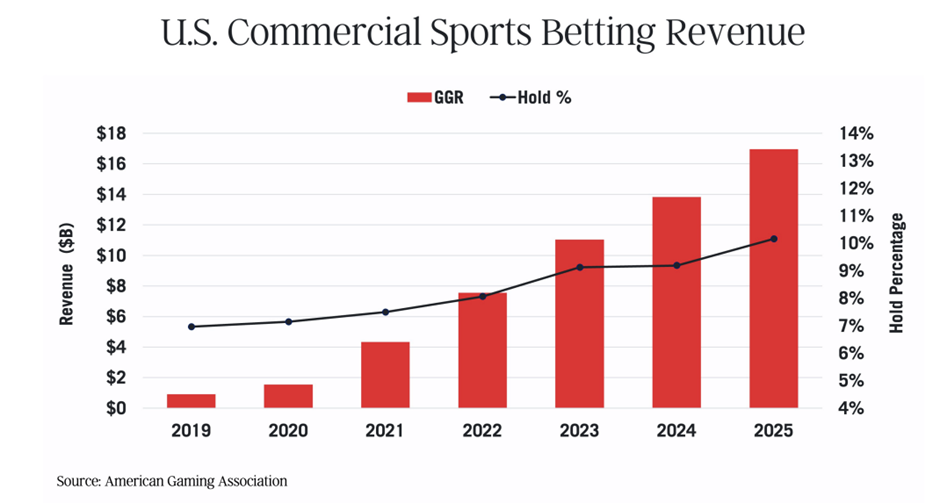
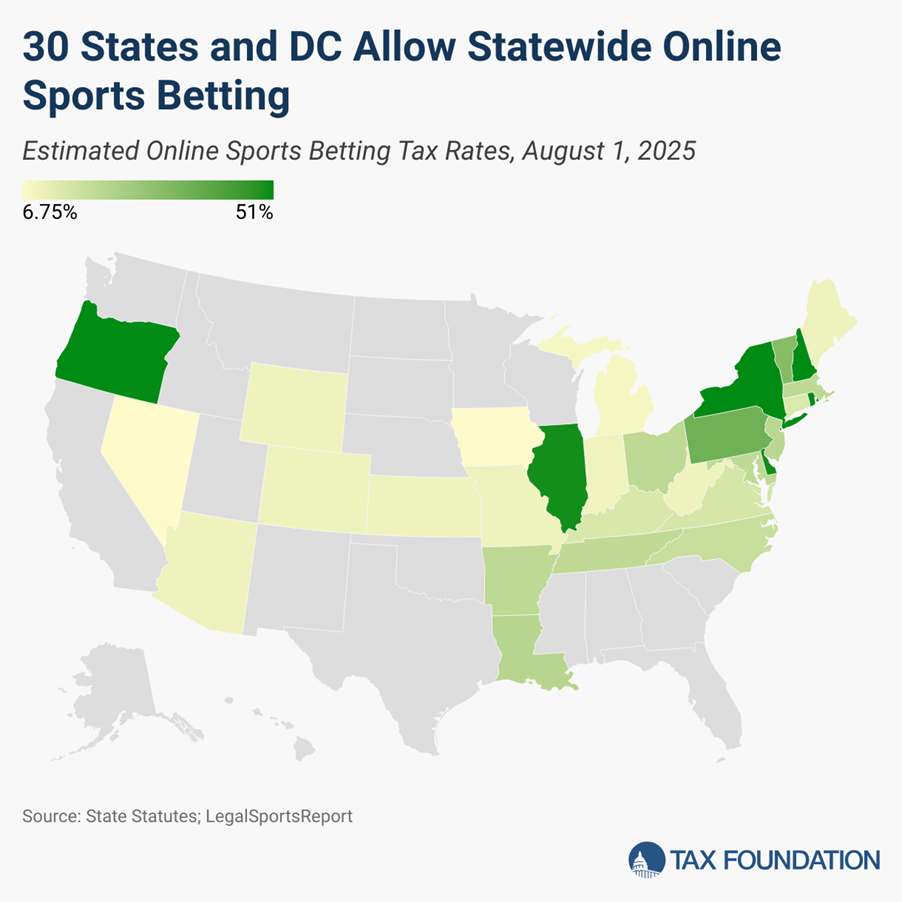
In 2018, the US Supreme Court struck down PASPA (Professional and Amateur Sports Protection Act of 1992), handing over sports betting regulations to be set by individual states, marking the start of the betting boom in the US. To date, 38 states allow sports betting; of those, 30 allow online sports betting. Revenues from sports betting have grown massively from just shy of $1B in 2019 to over $16B in 2025, showing a 60% CAGR.
Political volatility and a surge in gambling popularity, particularly among young Americans, are fuelling a new wave of events to bet on and a large group of bettors to do so. Prediction markets such as Kalshi and Polymarket have experienced a huge influx in users with $63.5B in trading volume in 2025, roughly up 300% from 2024, when it was $15.8B. In comparison, the US sports betting trading volume was $167B, up 11% from 2024, meaning prediction markets outperformed traditional sportsbooks.
Prediction markets function less like a traditional sportsbook and more like a stock exchange, with buyers and sellers setting and agreeing on prices using Polymarket, for example, as a vehicle for the trade.
For example, looking at the upcoming Champions League match between Sporting Lisbon and Arsenal, assuming the odds of Arsenal winning are 50%, a traditional sportsbook may offer 1.9x odds, just short of a 2x return you may expect with a 50:50. This returns a 90% profit on the bettor’s stake, with these odds the house gains a 5% edge looking at expected returns.
Whereas on a prediction market, the ‘odds’ are set by the players. Player 1 may offer any amount of shares at 50p, reflecting the real chance of Arsenal winning, player 2 would then offer the other 50p backing Arsenal not to win. The winner would then claim the full £1 for each share, with the market taking 1-2% commission on average. By doing this, players remove the house edge pre-set in the odds, which would usually be greater than the 1-2% cut.
Kalshi and Polymarket, founded in 2018 and 2020 respectively, were created with the goal of allowing gambling on political events such as election results. More recently, the sites have offered the chance to sports bet, which has massively boosted their revenues, reportedly accounting for 89% of Kalshi’s 2025 revenue.
They were both valued at over $20B in their recent raises. This makes them the 2nd and 3rd highest value betting and gambling companies behind only Las Vegas Sands, owners of multiple luxury casino resorts around the globe. To date, they have raised over $4.5B, most recently was Kalshi raising $1B in March 2026, only months after raising another $1B at the end of 2025. Kalshi’s income for 2025 was $263.5m, giving a revenue multiple just shy of a staggering 84x. Investors in these raises include: Sequoia, a16z, Paradigm, Coatue, and Intercontinental Exchange. So why are these top investors so hot on prediction markets, and why are their valuations so high?
1. Hugely scalable – their business models have little cost with each bet, taking a small cut of profits, their revenues scale with trade volume, which rises with more players who, in turn, bring in more players
2. ‘The legal loophole’ – as they are not classed as gambling companies, they pay significantly less in licenses and taxes in comparison to traditional bookies, who may pay up to 51% gaming tax in some states, as well as expensive licenses, which can go up to tens of millions of dollars for some states
3. Far larger market size – as wagers are created and set by players, betting on anything is possible. This means that, where traditional gambling is limited by laws and licensing, prediction markets can still operate in those markets
The major risk for prediction markets is their legal classification. Currently, Kalshi and Polymarket US are classed as an exchange under the CFTC (Commodity Futures Trading Commission) and hold a DCM (Designated Contract Market), meaning they can operate exactly like a stock exchange, avoiding the high gaming tax rates that some states are trying to impose. This means that they are federally regulated, and they are less vulnerable to state control, where traditional online gambling may be illegal.
To date, Kalshi has won 3 cases against Nevada, New Jersey, and Tennessee, combatting their attempts to enforce regulations and taxation, stating they were a platform for trading financial derivatives, not gambling. On the flip side, Massachusetts and Maryland have been successful in their outlawing of the site’s sports betting markets, establishing them as sports bets and not the derivatives Kalshi claims them to be. Currently, they are involved in 11 other cases across multiple states that are fighting for regulation, taxation, and in some cases, complete bans.
Unlike Kalshi, Polymarket is an international corporation based in Panama, making it less susceptible to US rules, regulations, and most significantly, taxation. However, issues arose from this as users were limited to cryptocurrency payments, and they did not have the rights of a US-based corporation. Therefore, in July 2025, Polymarket acquired QCX LLC, rebranding it as Polymarket US, which operates similarly to Kalshi using the ‘stock exchange’ model.
In the UK, prediction markets are classified as gambling, and as Polymarket and Kalshi do not have UK gambling licenses, they are unable to operate within the UK. Many countries across the EU have fully banned the sites, deeming them morally questionable and concerning in relation to predictions relating to wars and deaths of heads of state, as well as issues arising due to insider trading, tax evasion, and money laundering.
Whilst there are strong legal headwinds that could limit their potential, consumer interest in prediction markets remains high and there is still significant scope for growth and evolution. One new feature is the recent addition ACCA/Parlay functionality to Kalshi, historically a difficult problem for prediction markets to solve. Parlay-style betting has become immensely popular in the US as younger audiences seek bigger potential payouts, and providers are clearly looking to continue to evolve to match where they see demand.
https://www.americangaming.org/wp-content/uploads/2026/03/CY-2025_CGRT.pdf
https://a16zcrypto.com/posts/article/the-super-bowl-of-prediction-markets
https://taxfoundation.org/data/all/state/online-sports-betting-taxes/
https://playtoday.co/blog/stats/gambling-taxes-by-us-states/
https://www.forbes.com/sites/boazsobrado/2025/12/16/how-prediction-markets-actually-grew-in-2025

Ready to take your sports start-up to the next level? Let's collaborate and redefine the game together.
Whether you want to bet on the price of Bitcoin in 5 minutes, how many tweets Elon Musk will post, or the number of cars passing through any given traffic light, all is possible with prediction markets.
In 2018, the US Supreme Court struck down PASPA (Professional and Amateur Sports Protection Act of 1992), handing over sports betting regulations to be set by individual states, marking the start of the betting boom in the US. To date, 38 states allow sports betting; of those, 30 allow online sports betting. Revenues from sports betting have grown massively from just shy of $1B in 2019 to over $16B in 2025, showing a 60% CAGR.
Political volatility and a surge in gambling popularity, particularly among young Americans, are fuelling a new wave of events to bet on and a large group of bettors to do so. Prediction markets such as Kalshi and Polymarket have experienced a huge influx in users with $63.5B in trading volume in 2025, roughly up 300% from 2024, when it was $15.8B. In comparison, the US sports betting trading volume was $167B, up 11% from 2024, meaning prediction markets outperformed traditional sportsbooks.
Prediction markets function less like a traditional sportsbook and more like a stock exchange, with buyers and sellers setting and agreeing on prices using Polymarket, for example, as a vehicle for the trade.
For example, looking at the upcoming Champions League match between Sporting Lisbon and Arsenal, assuming the odds of Arsenal winning are 50%, a traditional sportsbook may offer 1.9x odds, just short of a 2x return you may expect with a 50:50. This returns a 90% profit on the bettor’s stake, with these odds the house gains a 5% edge looking at expected returns.
Whereas on a prediction market, the ‘odds’ are set by the players. Player 1 may offer any amount of shares at 50p, reflecting the real chance of Arsenal winning, player 2 would then offer the other 50p backing Arsenal not to win. The winner would then claim the full £1 for each share, with the market taking 1-2% commission on average. By doing this, players remove the house edge pre-set in the odds, which would usually be greater than the 1-2% cut.
Kalshi and Polymarket, founded in 2018 and 2020 respectively, were created with the goal of allowing gambling on political events such as election results. More recently, the sites have offered the chance to sports bet, which has massively boosted their revenues, reportedly accounting for 89% of Kalshi’s 2025 revenue.
They were both valued at over $20B in their recent raises. This makes them the 2nd and 3rd highest value betting and gambling companies behind only Las Vegas Sands, owners of multiple luxury casino resorts around the globe. To date, they have raised over $4.5B, most recently was Kalshi raising $1B in March 2026, only months after raising another $1B at the end of 2025. Kalshi’s income for 2025 was $263.5m, giving a revenue multiple just shy of a staggering 84x. Investors in these raises include: Sequoia, a16z, Paradigm, Coatue, and Intercontinental Exchange. So why are these top investors so hot on prediction markets, and why are their valuations so high?
1. Hugely scalable – their business models have little cost with each bet, taking a small cut of profits, their revenues scale with trade volume, which rises with more players who, in turn, bring in more players
2. ‘The legal loophole’ – as they are not classed as gambling companies, they pay significantly less in licenses and taxes in comparison to traditional bookies, who may pay up to 51% gaming tax in some states, as well as expensive licenses, which can go up to tens of millions of dollars for some states
3. Far larger market size – as wagers are created and set by players, betting on anything is possible. This means that, where traditional gambling is limited by laws and licensing, prediction markets can still operate in those markets
The major risk for prediction markets is their legal classification. Currently, Kalshi and Polymarket US are classed as an exchange under the CFTC (Commodity Futures Trading Commission) and hold a DCM (Designated Contract Market), meaning they can operate exactly like a stock exchange, avoiding the high gaming tax rates that some states are trying to impose. This means that they are federally regulated, and they are less vulnerable to state control, where traditional online gambling may be illegal.
To date, Kalshi has won 3 cases against Nevada, New Jersey, and Tennessee, combatting their attempts to enforce regulations and taxation, stating they were a platform for trading financial derivatives, not gambling. On the flip side, Massachusetts and Maryland have been successful in their outlawing of the site’s sports betting markets, establishing them as sports bets and not the derivatives Kalshi claims them to be. Currently, they are involved in 11 other cases across multiple states that are fighting for regulation, taxation, and in some cases, complete bans.
Unlike Kalshi, Polymarket is an international corporation based in Panama, making it less susceptible to US rules, regulations, and most significantly, taxation. However, issues arose from this as users were limited to cryptocurrency payments, and they did not have the rights of a US-based corporation. Therefore, in July 2025, Polymarket acquired QCX LLC, rebranding it as Polymarket US, which operates similarly to Kalshi using the ‘stock exchange’ model.
In the UK, prediction markets are classified as gambling, and as Polymarket and Kalshi do not have UK gambling licenses, they are unable to operate within the UK. Many countries across the EU have fully banned the sites, deeming them morally questionable and concerning in relation to predictions relating to wars and deaths of heads of state, as well as issues arising due to insider trading, tax evasion, and money laundering.
Whilst there are strong legal headwinds that could limit their potential, consumer interest in prediction markets remains high and there is still significant scope for growth and evolution. One new feature is the recent addition ACCA/Parlay functionality to Kalshi, historically a difficult problem for prediction markets to solve. Parlay-style betting has become immensely popular in the US as younger audiences seek bigger potential payouts, and providers are clearly looking to continue to evolve to match where they see demand.
https://www.americangaming.org/wp-content/uploads/2026/03/CY-2025_CGRT.pdf
https://a16zcrypto.com/posts/article/the-super-bowl-of-prediction-markets
https://taxfoundation.org/data/all/state/online-sports-betting-taxes/
https://playtoday.co/blog/stats/gambling-taxes-by-us-states/
https://www.forbes.com/sites/boazsobrado/2025/12/16/how-prediction-markets-actually-grew-in-2025
Accelerate Ventures
Accelerate Ventures 40-42 Hatton Garden London EC1N 8EB
