


40-42 Hatton
Garden London
EC1N 8EB

We live in the golden age of the quantified self. If you went for a run this morning, you likely strapped on a watch or strap or slipped on an Oura ring before heading out the door. We highly value the precise, actionable insights these devices provide
At Accelerate Ventures, we are deeply invested in the wearables market and believe they will continue to democratise fitness tracking. However, we are also keeping a close eye on a fascinating parallel development emerging at the elite level: improved optical tracking through newly available technologies.
At the heart of this shift is something called event-based vision. Think of a standard video camera: it records a fixed number of frames per second (30-60), regardless of whether anything is moving. Uncompressed recording an empty tennis court takes up just as much data as recording a high-speed rally. This creates massive video files that are slow to process.
Event-based cameras, however, are different.
Think of how your own eyes work. If you stare at a static wall, your brain doesn’t constantly “refresh” the image. It relaxes. But if a spider suddenly scuttles across that wall, your eye instantly detects the change and focuses on it.
New event-based sensors are beginning to be explored for sports and high-speed motion analysis. They don’t record frames; they output an asynchronous stream of per-pixel brightness changes, which is often driven by motion. In principle, this means they can capture hyper-fast movements, like the rotation of a baseball or a micro-stutter in a sprinter’s knee, with microsecond-level timing at speeds equivalent to thousands of frames per second, but with a fraction of the data load.
Imagine a stadium equipped with these cameras. They could significantly enrich movement analysis at scale, tracking joint angles, limb velocities, and even gait anomalies (with sufficient camera coverage and calibration).
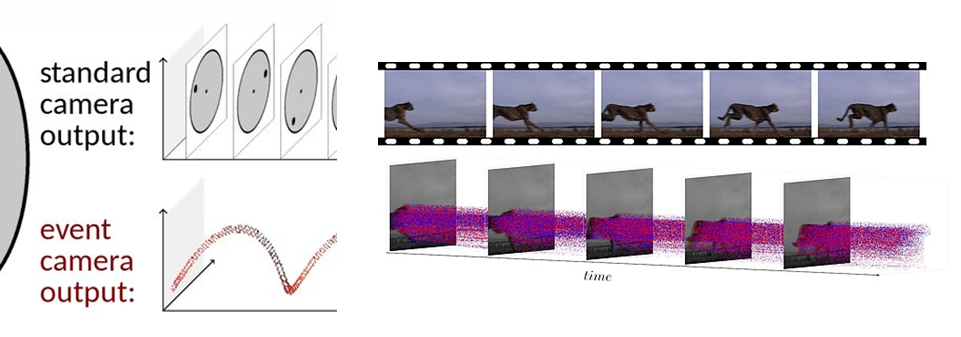
Traditional cameras show frozen frames; event-based cameras show a dotted trail of movement
To make sense of this new kind of visual data, another revolutionary technology comes into play: Spiking Neural Networks (SNNs). Unlike conventional AI, which processes information in large, continuous blocks, SNNs mimic the human brain. They only activate and consume power when they receive a spike of information.
For sports, this is profound. SNNs are brilliant at processing temporal data: information that changes over time. They don’t just see a static image; they understand the rhythm, velocity, and sequence of a movement. This allows them to:
Predict Injury Risks: Detect subtle deviations that are difficult to spot in real time, potentially providing earlier warning signals of fatigue or early injury – subject to validation
Optimise Biomechanics: Analyse the precise mechanics of a jump, a throw, or a swing, offering granular feedback to fine-tune performance
Operate with Extreme Efficiency: Because they only think when an event occurs, SNNs can run on incredibly low power, making them ideal for integration into stadium cameras or even subtle, future smart devices
| Traditional Computer Vision | Event-Based Computer Vision | |
| Input | Frames at fixed rate (e.g. 30–60 fps) | Asynchronous brightness-change events |
| AI Model | CNNs/Transformers (frame-based) | Event-based Deep Learning and/or SNNs |
| Processing | Often GPU-heavy; cloud or edge | Potentially lower power (neuromorphic) |
| Resolution | High spatial detail; good for visuals | High temporal; good for biomechanics |
Technology that starts in F1 cars eventually ends up in family sedans. The same principle applies to sports tech.
While invisible tracking is currently expensive and aimed at professional arenas, the potential for the mass market could be significant, if the technology can be made affordable.
Personalised Rehabilitation: Precise tracking could revolutionise physical therapy, ensuring exercises are performed correctly with new levels of accuracy
Enhanced Fan Experience: Imagine broadcast overlays that estimate workload or fatigue risk indicators, all derived from movement and context data
This will require substantial improvements in camera coverage and AI capabilities, and may well be a way off yet. But we believe the future of sports data isn’t about discarding the incredible value of wearables, but rather expanding the toolkit and coverage.

Ready to take your sports start-up to the next level? Let's collaborate and redefine the game together.
We live in the golden age of the quantified self. If you went for a run this morning, you likely strapped on a watch or strap or slipped on an Oura ring before heading out the door. We highly value the precise, actionable insights these devices provide
At Accelerate Ventures, we are deeply invested in the wearables market and believe they will continue to democratise fitness tracking. However, we are also keeping a close eye on a fascinating parallel development emerging at the elite level: improved optical tracking through newly available technologies.
At the heart of this shift is something called event-based vision. Think of a standard video camera: it records a fixed number of frames per second (30-60), regardless of whether anything is moving. Uncompressed recording an empty tennis court takes up just as much data as recording a high-speed rally. This creates massive video files that are slow to process.
Event-based cameras, however, are different.
Think of how your own eyes work. If you stare at a static wall, your brain doesn’t constantly “refresh” the image. It relaxes. But if a spider suddenly scuttles across that wall, your eye instantly detects the change and focuses on it.
New event-based sensors are beginning to be explored for sports and high-speed motion analysis. They don’t record frames; they output an asynchronous stream of per-pixel brightness changes, which is often driven by motion. In principle, this means they can capture hyper-fast movements, like the rotation of a baseball or a micro-stutter in a sprinter’s knee, with microsecond-level timing at speeds equivalent to thousands of frames per second, but with a fraction of the data load.
Imagine a stadium equipped with these cameras. They could significantly enrich movement analysis at scale, tracking joint angles, limb velocities, and even gait anomalies (with sufficient camera coverage and calibration).
Traditional cameras show frozen frames; event-based cameras show a dotted trail of movement
To make sense of this new kind of visual data, another revolutionary technology comes into play: Spiking Neural Networks (SNNs). Unlike conventional AI, which processes information in large, continuous blocks, SNNs mimic the human brain. They only activate and consume power when they receive a spike of information.
For sports, this is profound. SNNs are brilliant at processing temporal data: information that changes over time. They don’t just see a static image; they understand the rhythm, velocity, and sequence of a movement. This allows them to:
Predict Injury Risks: Detect subtle deviations that are difficult to spot in real time, potentially providing earlier warning signals of fatigue or early injury – subject to validation
Optimise Biomechanics: Analyse the precise mechanics of a jump, a throw, or a swing, offering granular feedback to fine-tune performance
Operate with Extreme Efficiency: Because they only think when an event occurs, SNNs can run on incredibly low power, making them ideal for integration into stadium cameras or even subtle, future smart devices
| Traditional Computer Vision | Event-Based Computer Vision | |
| Input | Frames at fixed rate (e.g. 30–60 fps) | Asynchronous brightness-change events |
| AI Model | CNNs/Transformers (frame-based) | Event-based Deep Learning and/or SNNs |
| Processing | Often GPU-heavy; cloud or edge | Potentially lower power (neuromorphic) |
| Resolution | High spatial detail; good for visuals | High temporal; good for biomechanics |
Technology that starts in F1 cars eventually ends up in family sedans. The same principle applies to sports tech.
While invisible tracking is currently expensive and aimed at professional arenas, the potential for the mass market could be significant, if the technology can be made affordable.
Personalised Rehabilitation: Precise tracking could revolutionise physical therapy, ensuring exercises are performed correctly with new levels of accuracy
Enhanced Fan Experience: Imagine broadcast overlays that estimate workload or fatigue risk indicators, all derived from movement and context data
This will require substantial improvements in camera coverage and AI capabilities, and may well be a way off yet. But we believe the future of sports data isn’t about discarding the incredible value of wearables, but rather expanding the toolkit and coverage.
Accelerate Ventures
Accelerate Ventures 40-42 Hatton Garden London EC1N 8EB
